
Sometimes the best thing you can do is blow up your own plan before someone else does it for you.
After an emotional rollercoaster of a week and accidentally coming across someone from London who makes my day so much brighter now, I finally sat down and rewrote my investment thesis for what I consider my most exciting pursuit in 2026: micro-acquisitions and micro private equity.
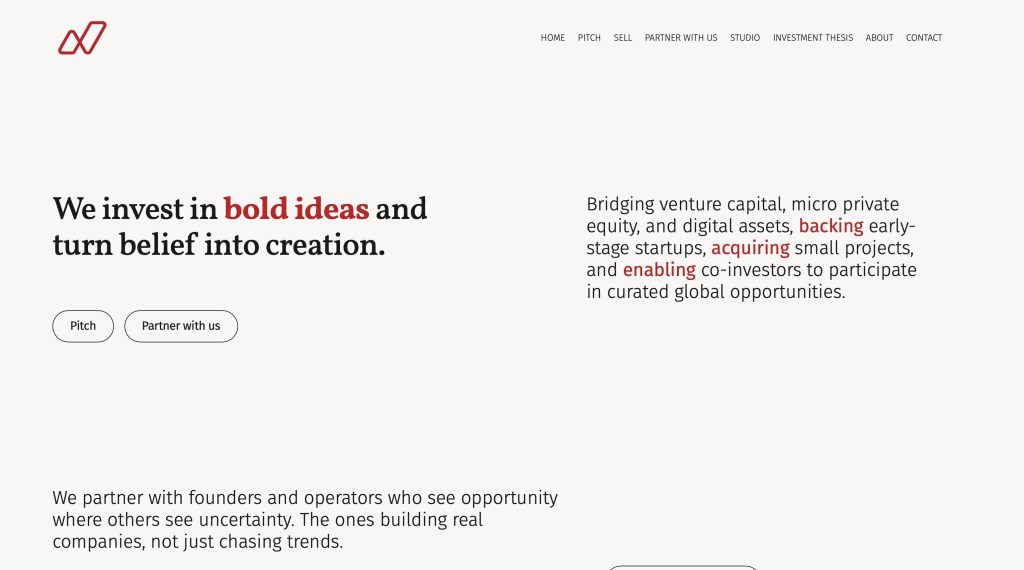
This has been simmering for a while. I’ve been quietly mapping out the details, building the framework, and yes, launching what is probably the most aggressively boring website on the internet. But it’s finance. It’s not supposed to be sexy.
Read also: My 2026 Goals: Going For A Home Run
When the Thesis Starts Talking Back
When I first wrote it, I was fired up. The thesis made sense in my head:
Acquire undervalued digital businesses, bridge VC capital, bring co-investors along for the ride, and potentially catch a unicorn in the process.
The more I read it back, though, the more I heard alarm bells.
It was too complicated. Way too complicated for an early-stage micro-PE firm that wants to build a clean, provable track record. I had layered ambition on top of ambition until the whole thing looked like a Frankenstein hybrid nobody asked for.
The core idea still holds. I want to find profitable digital businesses priced between $25K and $500K. Businesses that are too small for institutions to bother with, but too operationally complex for the average individual buyer to handle. That sweet spot is real, and I genuinely believe in it.
But everything around that core? It needed to go.
The Pitch That Killed My Confidence
I started floating the idea to some investor friends and angel investors. The response was not exactly what I hoped for.
They were confused. The hybrid PE/VC model reads as noise. Why buy small, messy businesses? Why drag in co-investors and absorb all their headaches?
The questions they were asking weren’t challenges to push back on. They were signals that I had overcomplicated something that should have been elegant.
So I wrote a short list for myself:
- Rewrite the thesis
- Simplify everything
- No outside money. Not yet
- Prove the model publicly with five acquisitions first
Once I let myself zoom out, it clicked almost immediately. Why bring in outside capital when I can move faster, stay flexible, and carry both the risks and rewards entirely on my own terms?
No investors knocking on my door. No one second-guessing every move. Just a clean playbook, a stable of skilled contractors, and one industry to focus on first.
Document everything. Repeat what works. That’s it.
The Real Challenge: Liquidity
I’m not going to pretend there isn’t a real constraint here.
Going solo means I have to be disciplined about capital preservation. Every acquisition needs a buffer. Not just for the purchase, but for the operational overhead that follows. The unglamorous stuff that makes or breaks the whole thing.
Because of this, I’m scaling back my upper acquisition limit from $500K to $200K per business. Honestly? I think that might end up being an advantage rather than a limitation.
The businesses sitting in that range are often pre-revenue or early-growth. Founders who have something real, but lack the commercial instincts or operational bandwidth to push from “working” to “scaling.” That’s precisely the gap I feel equipped to close.
What Comes Next?
Now that the thesis is almost rewritten and will be published soon, the real work begins.
I need to build the right team. A network of skilled contractors who can collectively cover the full operational spectrum post-acquisition.
Ideally, a right-hand person who either wants to go fully freelance or step into something more permanent.
Finding people with the right combination of skill, grit, and alignment, scattered across time zones and backgrounds, is genuinely hard.
More details coming soon. And yes, the website is getting a makeover too.